
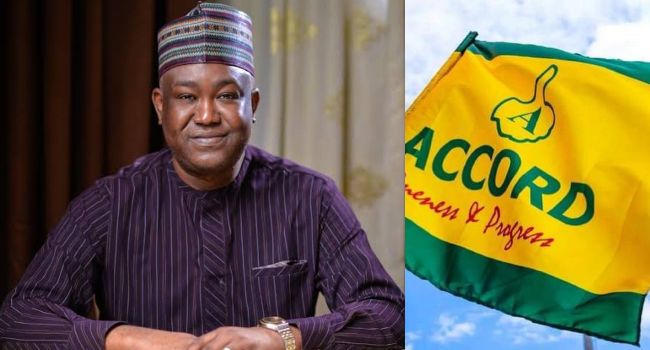

Presidential Candidate of the Accord Party, Gbenga Olawepo-Hashim, has said Nigerians should not have to pay more than ₦605 per litre for petrol under an Accord administration, arguing that the price could eventually fall to as low as ₦200 per litre if Nigeria gets its production costs and exchange rate right.
Hashim said the proposed price would represent a starting sustainable price, not an artificially subsidised price, and insisted that the reduction would not come at the expense of government revenue or Federation Account Allocation Committee (FAAC) revenues.
“₦605 per litre is our starting sustainable price for petrol. Nobody will buy petrol above ₦610 under our government. It could be as low as ₦200.”
He said the key to achieving the price was not another opaque subsidy regime but a fundamental correction of what he described as Nigeria’s distorted petroleum cost and accounting structure.
Hashim, who has consistently opposed the removal of petroleum subsidy, described the previous justification for subsidy removal as “accounting magic”, arguing that Nigeria must first establish the genuine cost of producing, refining, transporting and distributing petrol before declaring that government is subsidising consumers.
“Any time you sell a product above its legitimate cost of production, refining, transportation and insurance, you cannot call the difference between that price and an international benchmark a subsidy loss. That is opportunity cost.”
According to him, Nigeria has often approached petroleum pricing by comparing the domestic value of crude or refined products with international market prices, rather than determining what it actually costs Nigeria to produce and deliver the product to Nigerian consumers.
He said this creates a misleading impression that government is necessarily making a loss whenever Nigerians receive petroleum products below an international benchmark.
“A country does not subsidise itself simply because it chooses to use its own resources to provide affordable energy to its citizens.”
Hashim called for an independent forensic audit of Nigeria’s petroleum cost structure, covering crude production, contracting, procurement, refining, transportation, storage, insurance, pipeline operations and distribution.
He said the audit should establish the actual cost of producing and delivering every litre of petrol to the Nigerian market.
“Show Nigerians the books. Publish the production cost. Publish refinery cost. Publish transportation. Publish insurance. Publish every margin. Let the data speak.”
The Accord candidate argued that Nigeria’s high petroleum costs cannot simply be passed on to consumers without examining the reasons behind them.
He questioned the country’s relatively high production costs compared with major oil-producing economies, arguing that contracting, procurement, insecurity, operational inefficiency and possible cost inflation deserve closer scrutiny.
“Before asking Nigerians to pay more, government must first explain why it costs so much to produce our own oil. If the cost is genuine, show us the evidence. If it is inefficiency, corruption or inflated contracting, fix it.”
Hashim said Nigerians were effectively paying twice for the weaknesses of the petroleum sector: first through inefficient and inflated production costs, and again through higher prices at the pump.
“The Nigerian people should not pay for inefficiency twice. They should not pay for inflated costs inside the system and then be told that the resulting high price is the inevitable consequence of subsidy removal.”
He said his proposed pricing framework would be based on two fundamental variables, an appropriate production cost and an appropriate exchange rate.
Hashim said his administration would target an exchange rate of between ₦525 and ₦700 to the US dollar, arguing that exchange-rate stability would substantially affect the naira cost of petroleum-sector inputs and the wider economy.
“We will achieve this strictly by ensuring appropriate production cost and appropriate exchange rate.”
He stressed that the proposed reduction would not be financed by reducing government revenue.
“The reduction will not be at the detriment of government revenue or below current FAAC. We are not going to make petrol cheaper by making government poorer.”
According to Hashim, the objective is to reduce the underlying cost of production rather than simply transfer the cost from government accounts to consumers or vice versa.
He argued that lower energy costs could also stimulate production, reduce transportation and manufacturing costs, increase household purchasing power and expand the economic base from which government generates revenue.
“Our objective is not simply cheap petrol. Our objective is a productive Nigerian economy in which affordable energy, stronger production and stronger government revenue reinforce one another.”
Hashim said the proposed ₦200–₦300 per litre price should therefore be understood as a potential medium-term outcome of correcting the country’s economic fundamentals, rather than an arbitrary political promise.
“₦605 is the starting sustainable price. If we get production costs right and achieve the exchange-rate target, the price could come down to ₦200 or ₦300.”
He said the policy would also be accompanied by accelerated domestic refining, greater transparency in the petroleum value chain and measures to eliminate waste and leakages.
Hashim maintained that subsidy itself should not be treated as automatically illegitimate, provided that any intervention is transparent, targeted and designed to achieve measurable economic objectives.
“The issue is not whether government can intervene. The issue is whether government intervention is transparent, productive and accountable. Subsidy should protect Nigerians and the productive economy, not enrich intermediaries.”
He said the debate over petrol pricing should therefore move beyond political slogans and focus on the underlying data.
“Let the data speak. Tell Nigerians exactly what it costs to produce the crude, what it costs to refine it, what it costs to transport it and what every margin represents. Then we can have an honest conversation about subsidy.”
Hashim said the 2027 election should ultimately be a contest over competing economic models and not merely competing political personalities.
“Nigeria does not have to choose between affordable petrol and government revenue. We can have both. But we must stop using accounting to hide inefficiency and start using economics to build prosperity.”